IT'S ALL ABOUT PLANT!

Plants are living organisms belonging to the kingdom Plantae. Precise definitions of the kingdom vary, but as the term is used here, plants include familiar organisms such as flowering plants, conifers, ferns, mosses, and green algae, but do not include seaweeds like kelp, nor fungi and bacteria. The group is also called green plants or Viridiplantae in Latin. -

HOUSEPLANTS

A houseplant is a plant that is grown indoors in places such as residences and offices. Houseplants are commonly grown for decorative purposes, positive psychological effects, or health reasons such as indoor air purification. Plants used in this fashion are most commonly, though not always, tropical or semi-tropical. -

FLOWERING AND FOLIAGE SHRUBS

A shrub or bush is distinguished from a tree by its multiple stems and shorter height, usually under 5–6 m (15–20 ft) tall. A large number of plants may become either shrubs or trees, depending on the growing conditions they experience. Small, low shrubs such as lavender, periwinkle and thyme are often termed subshrubs. -

TREES AND HERBS

In general use, herbs are any plants "with leaves, seeds, or flowers used for flavoring, food, medicine, or perfume" or parts of "such a plant as used in cooking". In botanical use, the term "herb" is employed differently, for any non-woody flowering plant, regardless of its flavor, scent or other properties, and thus includes only grass-like plants and forbs -

AQUATIC PLANTS, VINES, CACTUS, etc.

A cactus is a member of the plant family Cactaceae, within the order Caryophyllales. Cacti have a variety of uses: some species are used as ornamental plants, others are grown for fodder or forage, others for food (particularly their fruit). Most cacti live in habitats which are subject to at least some degree of drought. -

Showing posts with label Aquatic. Show all posts

Saturday, June 02, 2012

Riccia fluitans


Plant Profile
Scientific Name: Riccia fluitans
Common Name: Riccia fluitans
Difficulty: Easy
CO2 Requirements: Moderate
Lighting Requirements: High
Plant Arrangement: Midground
Growth Rate: Fast
Family: Ricciaceae
Genus: Riccia
Origin: Worldwide
Plant Type: Floating
Water Hardness: Medium (GH = 9-13 dH)

Description
Background History
Riccia fluitans is a versatile liverwort (cells of the plant carry only a single set of genetic information) used in planted aquariums since the 1970s. Riccia fluitans, commonly known as Crystalwort, is also a lush floating plant. Due to its versatility, it is often used for intricate aquascaping in show aquariums. This does not mean that it is for experts only; even novice aquarists can normally keep Riccia fluitans without any trouble. Riccia fluitans should not be kept with vigorous plant eaters, because this plant does not cope well with such attacks.

Popularized by the Japanese Aquascaper, Takashi Amano, Riccia fluitans has become a fan favorite of Nature Style Aquarium Aquascapers. The plant is composed of several tiny plants that can be nestled together to form a beautiful foreground carpet, or even a midground transitional plant.
Riccia fluitans can be found worldwide and is widely available in specialized aquatic plant stores, and through hobbyist’s forums. It occurs naturally in the wild as a floating plant in slow-flowing streams and ponds. Fish fry often take refuge within the network of interconnected moss-like strands.

Growth Characteristics
Although Riccia fluitans is a naturally floating plant, following Amano’s lead, aquascapers from all over the world have netted and submerged the Riccia fluitans branches to grown them out into beautiful lush foregrounds and rock mounds. This liverwort is considered easy to grow, as long as there is ample light and carbon dioxide.
Riccia fluitans is a high maintenance plant due to its rapid growth and no root structure. When left floating close to the light source it can easily double in size within five days time. When submerged, the growth rate is slightly slower, but still requires weekly trimming to shape it into a nice manageable mound, or foreground. If left to overgrow, pieces of Riccia fluitans do have a tendency to break away from the main mass, and wind up in other plants or around a filter’s intake.

 Close-up Riccia fluitans


Aquascaping Application
Riccia fluitans forms thick clusters of bright green threads. If you refrain from pruning, Riccia fluitans will grow into a sphere shaped clump with slightly flattened “poles”, quite similar to planet Earth. Small clumps of Riccia fluitans normally float at or just below the surface. As the plant grows bigger and heavier, it will gradually sink down into the water.

Riccia fluitans does not develop any real root system, but it can anchor itself to solid objects such as rocks and branches. Use a piece of string or a rubber band to attach your Riccia fluitans to begin with and remove the string/rubber band when the plant has anchored itself. In some cases, there will be no need to remove the thread because it will be completely covered in lush green.

Aquascapers submerge Riccia fluitans by securing it around rocks using thin hairnets or sewing thread. Wedged tightly between the rock and the hairnet/thread, the fine Riccia branches will grow in between the cracks, and form an interlaced bushy Riccia mound. Remember, Riccia has a tendency to grow to the shape of the item it is attached to. For a flat foreground appearance, attached Riccia to a thin slate rock or heavy wire mesh. For a more hilly effect, use various sized round rocks.
 Heavy wire mesh for a flat lawn effect
Well-grown riccia planted on heavy wire mesh
 Anchoring riccia under thin net onto small rock
 Riccia fluitans tied on pieces of wood
 Riccia tied using fishing line on slate rock
Clusters of Riccia fluitans mounted on boulders


Trimming or thinning out Riccia is essential so that the lower portions of the plant will still see light and remain secured underneath the mesh. For trimming maintenance, it is best to turn off the filter first, and then trim with scissors. Net all floating bits before turning the filter back on.
Riccia looks stunning as the sole plant in a planted aquarium, or it can be easily paired with other foreground species such as Hemianthus callitrichoides (HC), or Eleocharis parvula (dwarf hairgrass) to complete an Iwagumi style layout.
For those who may grow tired of maintaining Riccia masses, there is a dwarf variety of Riccia Fluitans which contains smaller branches, and has a slower growth rate. The aquascaping possibilities with Riccia fluitans are limitless.

Riccia fluitans in the aquarium
As mentioned earlier, Riccia fluitans is a truly versatile plant that can be utilized in a wide range of ways on the aquarium. Even though it is a floating plant, it can be grown completely submerged. You can let it float free or anchor it to rocks and driftwood to make an “aquarium lawn”. You can let it grow over larger rocks and/or ledges in the aquarium to create a green, hilly landscape.


Riccia fluitans care
Caring for Riccia fluitans is not an arduous task, unless you wish to spend a lot of time pruning into specific shapes. Riccia fluitans is found in a rich assortment of various habitats in many different parts of the wild, and can tolerate a water temperature from 15 to 30 degrees C. This means that you can keep it with a wide range of different fish species. The water hardness can be medium soft to really hard and the pH-value can vary from 6.0 to 8.0.

In fry rearing aquariums

Ricca fluitans provides great shelter for fry, and small fry can also feed on micro organisms that live on this plant. You can either let your Ricca fluitans float at the surface, or anchor it down and create a “lawn” in which eggs and fry can stay hidden. By including plenty of Ricca fluitans, you can actually achieve a rather high survival rate even when fry is left in the same aquarium as adult fish. If you do not wish to set up a separate fry rearing aquarium, adding plenty of Ricca fluitans is a great alternative for many species.

Wednesday, May 09, 2012

AQUATIC PLANT - Anubias barteri var. nana


Common Name: Anubias nana
Scientific Name: Anubias barteri var. nana
Geographic Location: Central Africa

CO2 Requirements: Very Low
Temperature: 72F-80F
Water pH level: 5.5-9.0
Light: Low (1.5WPG) to Moderate (2.5WPG)

Plant Arrangement: Foreground
Growth: Slow
Difficulty: Very easy


Anubias tied up to a rock, avoid floating

Anubias are an extremely hardy creeping plant from Africa, but most varieties grow far too large for normal sized aquariums. However, the Anubias nana is one of the smaller varieties, growing only about 6 inches tall. Like other Anubias, the Anubias nana grows very slow, at about one new leaf a month. The leaves are thick and rigid and almost nothing will eat them, making it perfectly suited for aquariums with more destructive fish. The leaves can also last for months, if not years.


A clump of well-rooted Anubias nana

Anubias are similar to Java Ferns in that they grow off of a rhizome which must not be buried in the substrate. For best results, tie the rhizome to a piece of driftwood or rock, and the roots of the Anubia will soon anchor the plant. Also, placement is key for these plants as they creep horizontally more than vertically and grow in one direction, so plan accordingly. In order to trim an Anubia, simply cut off part the rhizome with sharp scissors or a knife, making sure to cut enough rhizome to contain a few leaves if you wish to keep the trimmed portion to grow into another plant.

Anubias nana makes few demands in terms of nutrients or light. In fact, because the leaves grow so slowly and last so long, high light leads to algae growth on the surface of older leaves. Therefore, place the Anubia nana out of direct light, or in an aquarium with moderate light. An Anubia will grow with almost no attention and needs very little fertilization. Even with ample fertilization and CO2, you will not see much of an increase in growth.


Perfect for beginners or those who never thought they could grow plants due to destructive fish or low light, Anubias nana can add contrast to an aquascape with large, lush bright green leaves like the picture above and require very little or no effort to maintain.

 Anubias nana also ideal for small planted tank
Forming lush dense cluster in an aquarium midground
 Creeping Anubias suits well with driftwood
Anubias nana placed in the middle of the aquarium

Tuesday, April 10, 2012

Amazon Sword (Echinodorus amazonicus)

[Freshwater Plant]
Common Name: Amazon Sword
Proper Name: Echinodorus amazonicus
Category: Echinodorus
Temperature: 20 - 28 C
PH: 6.0 - 7.6
Lighting: Medium
Growth Rate: Slow
Difficulty: Medium
Origin: Brazil
Position in Aquascape: Background
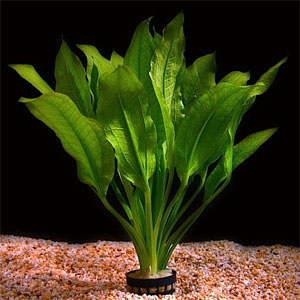
The Amazon Sword Plant, Echinodorus amazonicus, is a Rosette plant (Any plant with its leaves radiating outwards from a short stem at soil level) that is very popular with aquarium hobbyists. They are capable of reaching approximately 20 inches in height under proper water conditions. The Amazon Sword Plant has short rhizomes, numerous lance shaped leaves that are pale to dark green with sharply pointed tips, and fairly short stems. It is an amphibious plant that will grow either partially or fully submersed.
For the most beautiful Amazon Sword Plants, a loose substrate and with an iron-rich fertilizer must be used. The Amazon Sword Plant requires at least 2 watts per gallon of full spectrum lighting (5000-7000K). The aquarium temperature should be from 72°-82°F, with an alkalinity of 3 to 8 dKH and a pH of 6.5-7.5. Propagation is by adventitious plants on the covered peduncles (stalks).
Best cultivated in large aquariums, Amazon Sword Plants make a great focal point if used singly. When used in groups, they create an interesting background when grown with other aquarium plants.


Origins: Oddly enough, Amazon sword plants originally came from the Amazon River. These days they come mostly from Florida and Fareast plant farms. Florida farms produce bare root as well as potted swords. The Fareast farms send us only bare root specimens because of U.S. import regulations. High air freight rates also make bare root stock more practical. 
Many Varieties: You’ll find several types of sword plants under the “Amazon” label. You’ll even find different species called Amazon swords. Certain farms produce their own particular strains. Others cross different species to come up with hybrids under the same rubric.
Starting Suggestion: Strip any damaged leaves off your new swords. Snip off any non-white roots. And snip the tips off any healthy roots. All these nips and snips encourage new growth.
Reproduction: Amazon swords usually reproduce by root division and by seed. Root division keeps the strain pure. Seeds produce the hybrids and the largest “litters.” Root division works best in your aquarium. Most sword keepers never see an adult sword plant bloom and produce seeds. Many Fareast plant farms use microbiology to turn out acres of identical sword plants. Do not attempt this at home. 
Broad-leaf amazon sword in aquarium
Substrate: Swords grow best in smaller grained substrates about the size of a b-b. Adding clay to the substrate helps a lot. Mixing in large quantities of vermiculite helps even more. Some growers add soil. We think soil’s way too messy to use.
Fertilizers: The laterite products on the market were developed specifically to help you grow sword plants. Swords also respond very well to leaf fertilizers and even better to root fertilizers. Avoid over fertilizing them.
Lighting: If you’re serious about your swords, put a timer on your tank and give them exactly 12 hours of good light. Deep tanks require more bulbs than shallow tanks. Swords respond well to nearly any good light source.
Algae Problems: Too much light will cause algae to grow on your Amazon sword leaves. YOU cannot remove it. The Siamese algae eating sharks and the algae-eating shrimps can do the job. Otocinclus help a great deal also. Never add a plecostomus.

Other Threats:Plecos skin their leaves and make them look like lace plants.Silver dollars eat them down to their roots.So will Colombian ramshorn snails and apple snails.Big cichlids like to uproot them.Keep turtles and crayfish out of any plant tank.
Plecos fish
Cichlids fish
Apple snail

Colombian ramshorn snail

Silver dollar fish

Water: Amazon swords grow just fine in Des Moines water. Don’t get excited about pH values. And our water contains extra lime. Ignore it. Don’t add salt or use softened water (which adds salt).
Size: Most tank-raised Amazon swords grow 12 to18-inches tall. Oddly enough, too much light keeps them from growing tall. They flatten out. On the other hand, we’ve seen these plant grow up and out of a 70-gallon tank under hanging lights. These big momma plants grow flowers and make lots and lots of little baby swordlets.
Great Egg Site: If you keep breeder size angels, you’ll notice your angels prefer to spawn on Amazon sword plant leaves. They’re both from the same river. Angels can wreck their leaves when spawning.
Last Word: Amazon swords will survive and grow even under less than perfect conditions. That’s what makes them one of the most popular decorative plants. 

Thursday, December 29, 2011

Freshwater Plants

The variety of plants that can live in and around fresh water all over the world is quite extensive. Plants that can survive and thrive in wet, marshy areas or that live in and on top of water are called aquatic or hydrophytic plants (hydrophytes). Some aquatic plants grow completely beneath the surface, and some grow partially beneath and partially above. Aquatic plants can grow in the wild, or in aquariums and man-made  ponds.


Requirements


In addition to the hydrogen, oxygen and carbon found in the water and air that they live in, aquatic plants also need the nutrients that are found in the rich soil that is in and around freshwater ecosystems. These nutrients include a large range of macro-elements such as magnesium, nitrogen, phosphorous and potassium. Decomposing organic matter that surrounds freshwater areas adds to these nutrients.

Types
There are three major types of hydrophytic plants. There are plants that are rooted in the mud. These plants can have leaves that are either completely submerged in the water or that extend out of the water. The second type is floating plants whose roots do not attach to the bottom but float free in the water. The majority of these plants' leaves or flowers are above the surface. The third type is plants that are rooted in the mud along the edge of the water; they are somewhere between being an aquatic plant and a terrestrial plant.

1) Submerged Aquatic Plants

  • Anacharis
    Submerged aquatic plants help to produce oxygen in the water, and are very beneficial to aquatic life. For this reason, submerged plants are very popular with aquarium owners. There are many species of submerged aquatic plants, including Anacharis, Cabomba, Hornwort, Red Ludwigia and Vallisneria
Vallisneria spiralis

Amazon sword

Riccia fluitans


        2) Floating Aquatic Plants


        • Water Lettuce
          Floating aquatic plants also help to oxygenate and filter the water. Floating plants are a favorite of those who create their own backyard ponds and Koi ponds. Some examples of floating plants are Frogbit, Large Leaf Sensitive Plant, Parrot's Feather, Red Stemmed Parrot's Feather, Water Hyacinth, Jumbo Water Hyacinth and Water Lettuce. The most popular versions of floating plants for the backyard Koi pond, mostly because of their beautiful blooms, are the Water Lily and the Lotus.
        Frogbit

        Salvinia natans

        Water hyacinth


          3) Bog Plants


          • Bengal Canna
            Aquatic plants that grow at the sides and on the banks of freshwater areas are sometimes called bog plants. These range from the grasses that grow in marshlands to Elephant Ears and Rushes. Some examples of bog plants are Arrowheads, Cattails and Reeds, Floating Hearts, Bog Irises, Louisiana Irises, Rushes, Cannas, Palms, Papyrus, Elephant Ear and Bog Taro.
          Moccasin flower orchid

          Acorus americanus

          Sarracenia

          Related Posts Plugin for WordPress, Blogger...

          Quick Wikipedia Search

          Search results

          WWF Message (Forests for Life)

          WWF Message (Forests for Life)
          Plants are disappearing. Every year over 11.5 million hectares of tropical forest is cut and then burned to clear land for farming and cattle grazing. This kind of change is called deforestation. With fewer trees and other plants to convert carbon dioxide to oxygen, too much carbon dioxide builds up. Deforestation is one cause of global warming. The conservation of plants and forests is now something more people and governments are beginning to discuss very seriously as one way to protect the environment.

          WWF Message (Before It's Too Late)

          WWF Message (Before It's Too Late)
          Plants are one of two major Kingdoms of life forms. There are about 300,000 plant species on Earth. Plants are the only life forms that can produce their own food using energy from sunlight. Plants produce almost all of the oxygen in the air that humans and other animals breathe. Plants are also an important source of food, building materials, and other resources that make life possible for Earth’s animals.

          International Aquatic Plant Layout Contest - 2012 Grand Prize

          International Aquatic Plant Layout Contest - 2012 Grand Prize