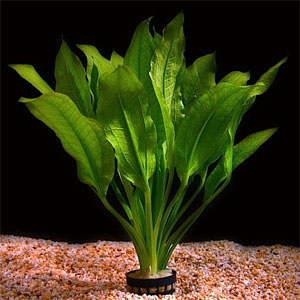
[Freshwater Plant]
| Common Name: | Amazon Sword |
| Proper Name: | Echinodorus amazonicus |
| Category: | Echinodorus |
| Temperature: | 20 - 28 C |
| PH: | 6.0 - 7.6 |
| Lighting: | Medium |
| Growth Rate: | Slow |
| Difficulty: | Medium |
| Origin: | Brazil |
| Position in Aquascape: | Background |
The Amazon Sword Plant, Echinodorus amazonicus, is a Rosette plant (Any plant with its leaves radiating outwards from a short stem at soil level) that is very popular with aquarium hobbyists. They are capable of reaching approximately 20 inches in height under proper water conditions. The Amazon Sword Plant has short rhizomes, numerous lance shaped leaves that are pale to dark green with sharply pointed tips, and fairly short stems. It is an amphibious plant that will grow either partially or fully submersed.
For the most beautiful Amazon Sword Plants, a loose substrate and with an iron-rich fertilizer must be used. The Amazon Sword Plant requires at least 2 watts per gallon of full spectrum lighting (5000-7000K). The aquarium temperature should be from 72°-82°F, with an alkalinity of 3 to 8 dKH and a pH of 6.5-7.5. Propagation is by adventitious plants on the covered peduncles (stalks).
Best cultivated in large aquariums, Amazon Sword Plants make a great focal point if used singly. When used in groups, they create an interesting background when grown with other aquarium plants.


Origins: Oddly enough, Amazon sword plants originally came from the Amazon River. These days they come mostly from Florida and Fareast plant farms. Florida farms produce bare root as well as potted swords. The Fareast farms send us only bare root specimens because of U.S. import regulations. High air freight rates also make bare root stock more practical.
Many Varieties: You’ll find several types of sword plants under the “Amazon” label. You’ll even find different species called Amazon swords. Certain farms produce their own particular strains. Others cross different species to come up with hybrids under the same rubric.
Starting Suggestion: Strip any damaged leaves off your new swords. Snip off any non-white roots. And snip the tips off any healthy roots. All these nips and snips encourage new growth.
Reproduction: Amazon swords usually reproduce by root division and by seed. Root division keeps the strain pure. Seeds produce the hybrids and the largest “litters.” Root division works best in your aquarium. Most sword keepers never see an adult sword plant bloom and produce seeds. Many Fareast plant farms use microbiology to turn out acres of identical sword plants. Do not attempt this at home.
Broad-leaf amazon sword in aquarium
Substrate: Swords grow best in smaller grained substrates about the size of a b-b.
Adding clay to the substrate helps a lot.
Mixing in large quantities of
vermiculite helps even more.
Some growers add soil.
We think soil’s way too messy to use.
Fertilizers: The laterite products on the market were developed specifically to help you grow sword plants. Swords also respond very well to leaf fertilizers and even better to root fertilizers. Avoid over fertilizing them.
Lighting: If you’re serious about your swords, put a timer on your tank and give them exactly 12 hours of good light. Deep tanks require more bulbs than shallow tanks. Swords respond well to nearly any good light source.
Algae Problems: Too much light will cause algae to grow on your Amazon sword leaves.
YOU cannot remove it.
The
Siamese algae eating sharks and the
algae-eating shrimps can
do the job.
Otocinclus help a great deal also. Never add a plecostomus.
Other Threats:Plecos skin their leaves and make them look like lace plants.
Silver dollars eat them down to their roots.
So will
Colombian ramshorn snails and
apple snails.
Big
cichlids like to uproot them.
Keep turtles and crayfish out of any plant tank.
Plecos fish
Cichlids fish
Apple snail
Colombian ramshorn snail
Silver dollar fish
Water: Amazon swords grow just fine in Des Moines water. Don’t get excited about pH values. And our water contains extra lime. Ignore it. Don’t add salt or use softened water (which adds salt).
Size: Most tank-raised Amazon swords grow 12 to18-inches tall. Oddly enough, too much light keeps them from growing tall. They flatten out. On the other hand, we’ve seen these plant grow up and out of a 70-gallon tank under hanging lights. These big momma plants grow flowers and make lots and lots of little baby swordlets.
Great Egg Site: If you keep breeder size angels, you’ll notice your angels prefer to spawn on Amazon sword plant leaves. They’re both from the same river. Angels can wreck their leaves when spawning.
Last Word: Amazon swords will survive and grow even under less than perfect conditions. That’s what makes them one of the most popular decorative plants.
Learn how to create a successful and long-lasting container garden with these expert tips.
Choosing the Best Soil
To create a successful container garden, the most important ingredient is good potting soil. Choose a mixture that provides a good combination of excellent drainage and aeration.
"Look for 'professional' on the label," suggests Dr. Susan Hamilton, who oversees the University of Tennessee Gardens. "That word puts the potting soil in a whole different category. You'll be paying a little bit more, but it will be high quality."
Many growers like to mix their own and prefer particular blends. "Every greenhouse manager has his or her favorite potting soil recipe, and each thinks theirs is the one to use," she says.
Here, says Hamilton, there are 3 great recipes:
Mix #1
2 parts peat(any type of peat): 1 part perlite: 1 part builder's sand
Mix #2
2 parts peat: 1 part builder's sand
Mix #3
1 part peat: 1 part builder's sand: 1 part pine-bark mulch/ any other kind of mulch
Peat Moss
Perlite
Pine-Bark Mulch
Builder's Sand
Is it really worth it to mix your own if you're a typical backyard gardener? "No," Hamilton says. "When you look at price and volume versus what you really need, you usually have a lot of material left over. Besides, bagged soils are pretty cost-effective because all the guesswork has been taken out of it. Professional blends have already been charged with starter nutrients and pH adjusted."
Selecting Plants
Select plants that are compatible in terms of light, water, growth and the conditions in the chosen site. Don't mix a shade- and water-lover like impatiens with a dry-and-sunny plant like thyme. Some plants like mint are such aggressive growers they need a pot of their own.
Watering Your Container Garden
Pay close attention to watering. For containers in sunny, hot or windy areas, watering twice a day may be necessary. A plant that has outgrown its pot will also need more frequent watering.
Consider using a water-absorbing polymer; it will improve the moisture retention of the potting soil. Follow the directions on the package.
Dressing Your Plants
Top-dress your plants with mulch and a slow-release fertilizer. You'll be reducing the evaporation rate and eliminating regular feedings.
Below are some pictures of the container garden ideas:
Article from hgtv.com under title of (Home > Outdoors > Gardening > How to Plant a Container Garden)
Here are some interesting and funny facts that I found about different plants. If you want a little light reading, continue on... :)
- An African bugleweed synthesises in its tissues a substance similar to the hormone that controls the development of caterpillars. If a caterpillar is persuaded, experimentally, to ingest that substance, then when it turns into a butterfly it will develop two heads and die. -David Attenborough, The Private Life of Plants, p70
Blue Bugleweed
- 84% of a raw apple and 96% of a raw cucumber is water.
- A notch in a tree will remain the same distance from the ground as the tree grows.
- A pineapple is a berry.
- Arrowroot, an antidote for poisoned arrows, is used as a thickener in cooking (so if you ever get shot with a poison arrow, do not go to a doctor, look in your kitchen cabinet.
Arrowroot
- Avocados have the highest calories of any fruit at 167 calories per hundred grams.
- Both George Washington and Thomas Jefferson grew cannabis sativa (marijuana) on their plantations.
- In the Netherlands, in 1634, a collector paid 1,000 pounds of cheese, four oxen, eight pigs, 12 sheep, a bed, and a suit of clothes for a single bulb of the Viceroy tulip.
- No species of wild plant produces a flower or blossom that is absolutely black, and so far, none has been developed artificially.
- Nutmeg is extremely poisonous if injected intravenously.
Nutmeg
- Peanuts are beans.
- Quinine, one of the most important drugs known to man, is obtained from the dried bark of an evergreen tree native to South America.
- The California redwood - coast redwood and giant sequoia - are the tallest and largest living organism in the world.
Redwoods State Park
- The largest single flower is the Rafflesia or "corpse flower". They are generally 3 feet in diameter with the record being 42 inches.
- The oldest living thing in existence is not a giant redwood, but a bristlecone pine in the White Mountains of California, dated to be aged 4,600 years old.
Bristlecone Pine Tree
- The rose family of plants, in addition to flowers, gives us apples, pears, plums, cherries, almonds, peaches and apricots.
- Asparagus is a member of the lily family, which also includes onions, leeks, and garlic.
- The bright orange color of carrots tell you they are an excellent source of Vitamin A which is important for good eyesight, especially at night. Vitamin A helps your body fight infection, and keeps your skin and hair healthy.
- Onions contain a mild antibiotic that fights infections, soothes burns, tames bee stings and relieves the itch of athletes foot.
- One bushel of corn will sweeten more than 400 cans of pop.
One Bushel of Corn
Famili: Guttiferae
Negara asal: Malaysia, Thailand, Myammar dan India Selatan

Pokok yang sederhana besarnya ini boleh mencapai ketinggian 20-30meter. Batangnya lurus dengan dahan-dahannya tumbuh mengelilingi batang. Hujung dahan-dahan ini pula melentur sedikit. Silaranya hampir tirus semasa muda dan rendang terbuka apabila matang. Daunnya oblong-lanseolat, 12-30cm panjang, 3-7cm lebar, berkilat, licin, berwarna kemerahan semasa muda dan bertukar hijau tua apabila matang. Petiol 2.5cm panjang dan buah berbentuk globos, 7-12cm diameter, berpangsa 12-16 dari atas ke bawah dan bertangkai 3-5cm panjang. Semasa muda buahnya berwarna hijau dan bertukar warna kuning limau apabila masak. Isinya setebal 2-2.5cm dan mengandungi 3-5biji yang diselaputi aril yang juga berwarna hijau limau.
Kegunaan dan Khasiat
Buah gelugur adalah tidak asing lagi bagi masyarakat Melayu dan sering digunakan sebagai penyedap rasa dalam pelbagai resipi masakan tradisional. Buahnya yang sudah cukup tua atau hampir masak akan dihiris nipis dan dijemur dibawah cahaya matahari. Hirisan buah yang kering boleh disimpan lama dalam bekas tertutup untuk kegunaan akan datang.
Gelugur yang telah dikeringkan ini disebut sebagai asam keping.
Asam gelugur seringkali digunakan dalam pelbagai resipi masakan seperti
laksa, asam pedas dan resipi tradisional yang memerlukan rasa masam. Rasa masam buah gelugur yang unik dapat merangsang dan menambah selera. Daun pokok asam gelugur yang masih muda dan berwarna kemerahan sering juga dijadikan ulam dan penyedap rasa dalam resipi masakan lauk-pauk.
Buahnya yang hampir masak boleh digunakan untuk
mencuci barangan daripada tembaga dengan cara menggosok hirisan buah pada bahagian terlibat.
Antara masakan Malaysia yang menggunakan asam keping:
Laksa Penang
Ikan Sambal
Udang Masak Lemak
Kari Kepala Ikan
Asam gelugur mengandungi khasiat yang agak sederhana. Dalam setiap 100g pengambilan
asam keping gelugur terkandung:
Air 30.3g, protein 2.7g, lemak 1.3g, karbohidrat 51.9g, serat 12.2g, kalsium 85mg, fosforus 38mg, ferum 6.9mg, natrium 27mg, kalium 351mg, karotena 155ug, vitamin A 26ug, vitamin B1 0.06mg, niasin 0.4mg dan vitamin C 3.6mg.
Manakala dalam setiap 100g pengambilan
daun muda atau pucuk gelugur terkandung di dalamnya:
Air 79.1g, protein 1.8g, lemak 0.4mg, karbohidrat 15.5g, serat 2.6mg, kalsium 63mg, fosforus 19mg, ferum 1.6mg, natrium 2mg, kalium 83mg, karotena 459ug, vitamin A 77ug, vitamin B1 0.06mg, B2 0.13mg dan vitamin C 37.2mg.
Pembiakan dan Penanaman
Pokok gelugur mudah dibiakkan dengan cara menyemai biji benih daripada buah yang sudah cukup masak. Pada peringkat awal pertumbuhan, anak pokok gelugur memerlukan sedikit lindungan daripada sinaran terus cahaya matahari. Pokok gelugur akan mula
berbuah selepas tempoh antara 10-15 tahun. Namun pada masa kini, kebanyakan pokok gelugur hanya dibiakkan dan ditanam lebih banyak di kawasan kampung dan kawasan pertanian tradisional.